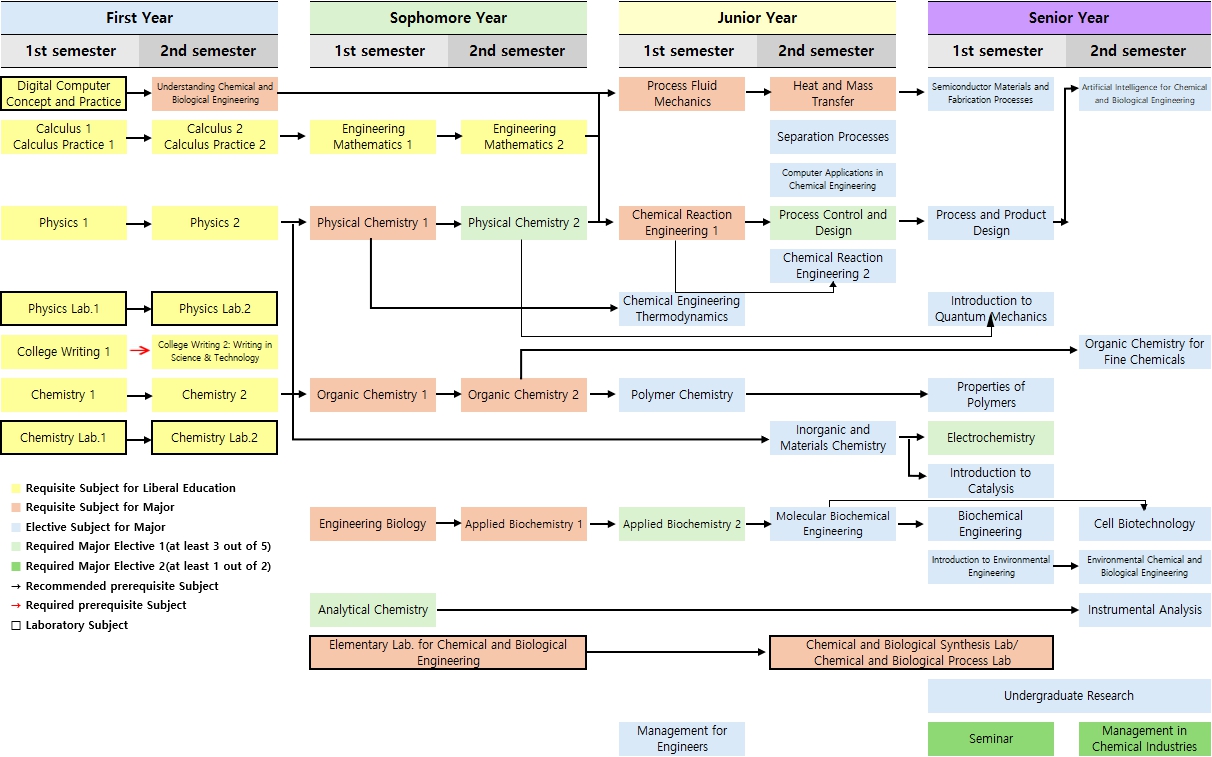
Curriculum Map
loaction

Curriculum Overview
The chemical industry is a foundational sector that not only produces essential materials such as clothing and food but also supplies the raw materials and components needed across all industrial activities. As a core technology area, it is crucial for addressing future global challenges, including environmental sustainability, energy supply, and human health and welfare. Given this significance, the chemical and biological engineering discipline plays a critical role in national industrial development and global competitiveness.
Today, the field encompasses a wide range of industries including petrochemicals, organic chemistry, process design and automation, consumer goods, and traditional sectors. At the same time, it underpins emerging industries such as materials science, biological engineering, environmental engineering, information technology, semiconductor and electronic materials, nanotechnology, synthetic biology, and green technologies. Its scope continues to expand rapidly.
Biotechnology, in particular, has evolved from traditional fermentation into a major driver of innovation in the pharmaceutical and biomedical industries. In Korea, this trend gained momentum with the 1973 introduction of genetic engineering. Today, applications such as biopharmaceuticals, gene therapy, and synthetic biology play a key role in the future of industry.
To prepare students for leadership in these areas, the undergraduate curriculum includes foundational courses such as General and Organic Chemistry (I, II), Physical Chemistry, Applied Chemistry, Engineering Mathematics, and Physics. It also offers advanced coursework in reaction engineering, chemical process systems, biochemical engineering, and practical lab training. Students are encouraged to explore interdisciplinary electives in areas such as entrepreneurship, management, and seminar courses that enhance their ability to solve real-world problems through research and innovation.
At the graduate level, research and coursework extend into specialized fields such as petrochemicals, organic synthesis, materials and nanomaterials, electronics, biotechnology, environmental and energy systems, catalysis, and advanced processing. Graduates of the program go on to successful careers in a wide array of industries, including petrochemicals, semiconductors, pharmaceuticals, display technology, cement, glass, polymers, and metals. Many also pursue careers in academia or government research institutions, contributing to both national and global innovation.
Today, the field encompasses a wide range of industries including petrochemicals, organic chemistry, process design and automation, consumer goods, and traditional sectors. At the same time, it underpins emerging industries such as materials science, biological engineering, environmental engineering, information technology, semiconductor and electronic materials, nanotechnology, synthetic biology, and green technologies. Its scope continues to expand rapidly.
Biotechnology, in particular, has evolved from traditional fermentation into a major driver of innovation in the pharmaceutical and biomedical industries. In Korea, this trend gained momentum with the 1973 introduction of genetic engineering. Today, applications such as biopharmaceuticals, gene therapy, and synthetic biology play a key role in the future of industry.
To prepare students for leadership in these areas, the undergraduate curriculum includes foundational courses such as General and Organic Chemistry (I, II), Physical Chemistry, Applied Chemistry, Engineering Mathematics, and Physics. It also offers advanced coursework in reaction engineering, chemical process systems, biochemical engineering, and practical lab training. Students are encouraged to explore interdisciplinary electives in areas such as entrepreneurship, management, and seminar courses that enhance their ability to solve real-world problems through research and innovation.
At the graduate level, research and coursework extend into specialized fields such as petrochemicals, organic synthesis, materials and nanomaterials, electronics, biotechnology, environmental and energy systems, catalysis, and advanced processing. Graduates of the program go on to successful careers in a wide array of industries, including petrochemicals, semiconductors, pharmaceuticals, display technology, cement, glass, polymers, and metals. Many also pursue careers in academia or government research institutions, contributing to both national and global innovation.